
A fifteen-year heritage with a six-week-old name
Beyond is what you get when five companies become one. CTS, a Manchester-founded pioneer of Google Cloud consultancy, merged with Appsbroker in 2023 to form Qodea — at that point Europe’s largest dedicated Google Cloud consultancy. TIQQE brought Swedish engineering depth and opened the Nordics. Tmc3 added public-sector-grade cybersecurity. Beyond LLC brought design, UX and digital product, and a first real foothold in North America. Then the whole thing rebranded as Beyond: one name over a business operating in nine countries, holding a Google security partner award, where more than 75% of the team are hands-on technical specialists.

The problem was the obvious one. The new name was around six weeks old when we were engaged, and much of the market, including parts of the Google ecosystem the business had worked in for years, still knew it by the names it used to have. The credibility was real. The recognition hadn’t caught up.
Joshua Morris, Beyond’s Head of Marketing, had joined roughly six weeks earlier with a mandate to build the marketing function and run a proper brand launch. He came to us through the contact form on 20 May, referencing the recruitment film we’d made for Rise Technical — he was the marketing lead on that project. We held the discovery workshop the same day.
His test for the film: put it in front of someone who knew the business as any of its previous companies, and have it clear up who Beyond is, what it does, and why it’s the best answer in its market.
The hard constraint was the date. The launch was fixed for the week commencing 22 June and could not move, with global campaigns scheduled from September. Whatever we made had to exist, finished, before then.
The schedule, in full
We’re publishing the actual dates because the schedule is the substance of this post.
| Date | What happened |
|---|---|
| 20 May | Enquiry received. Discovery workshop held the same day. |
| 21 May | Costed approach options presented. |
| 3 June | Creative outline reviewed. Contributors scheduled, location shortlisted. |
| 4 June | Production agreement signed. |
| 8 June | Shoot day — one day, East London. |
| 11 June | V1 delivered: the narrative assembly. |
| 15 June | V2 delivered. Narrative signed off. |
| 17 June | V3 delivered: animation in at scale. |
| 19 June | V4 delivered. Social cuts V1 delivered. |
| 22 June | Compile complete. |
| 23 June | Contracted delivery date met. |
| 30 June | All six social cut files finalised. |
| 3 July | Final hero master closed out, expanded scope included. |
Three numbers to hold onto: 34 days from the first conversation to contracted delivery. 19 days from contract signature. 15 days from the shoot itself.
Worth being equally straight about the tail. The contracted deliverable hit its date of 23 June and the launch went ahead with the film ready. The expanded scope — four numbered versions against a contracted two rounds of feedback, three social cuts in both aspect ratios, and a piece of extra work we’ll come to — closed out on 3 July, every addition approved in writing before it happened.

One shoot day. Four executives. Seven finished films.
The founding decision came out of the first workshop, and it was Joshua’s before it was ours: people first. Beyond sells expertise and partnership, not a product you can point a lens at, so the film had to be built from its actual people — directed interviews rather than a scripted voiceover. The arc we pitched ran in four moves: open on a confident statement of who Beyond is; fold in the origin story without dwelling in it; land on what the business is now and the scale it operates at; close on an invitation to work with them.
Two reference points did the heavy lifting in the pitch. A Notion brand film gave us the structural model — clear, a little quirky, unafraid of historical context. And our own film for AlTi Tiedemann Global, The Purpose of Wealth, set the benchmark for the finish. We presented two costed approaches the day after the workshop — a direct, personality-led route, and a more curated one with tighter art direction and roughly 30% more time in post. The contracted project sat closer to the second, and grew from there.
The shoot was one day, Monday 8 June, in a hired East London studio — chosen over Beyond’s own offices because a neutral space gave us controlled framing options rather than whatever the office happened to look like that Monday. A crew of five. Two cameras on every interview, shallow depth of field, lighting built for shape rather than coverage.
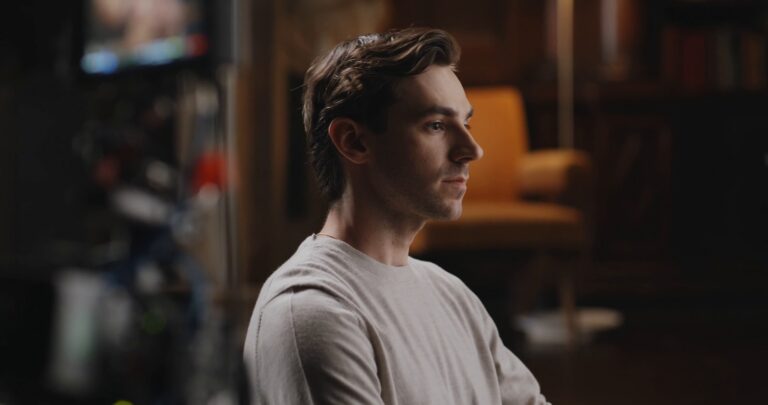
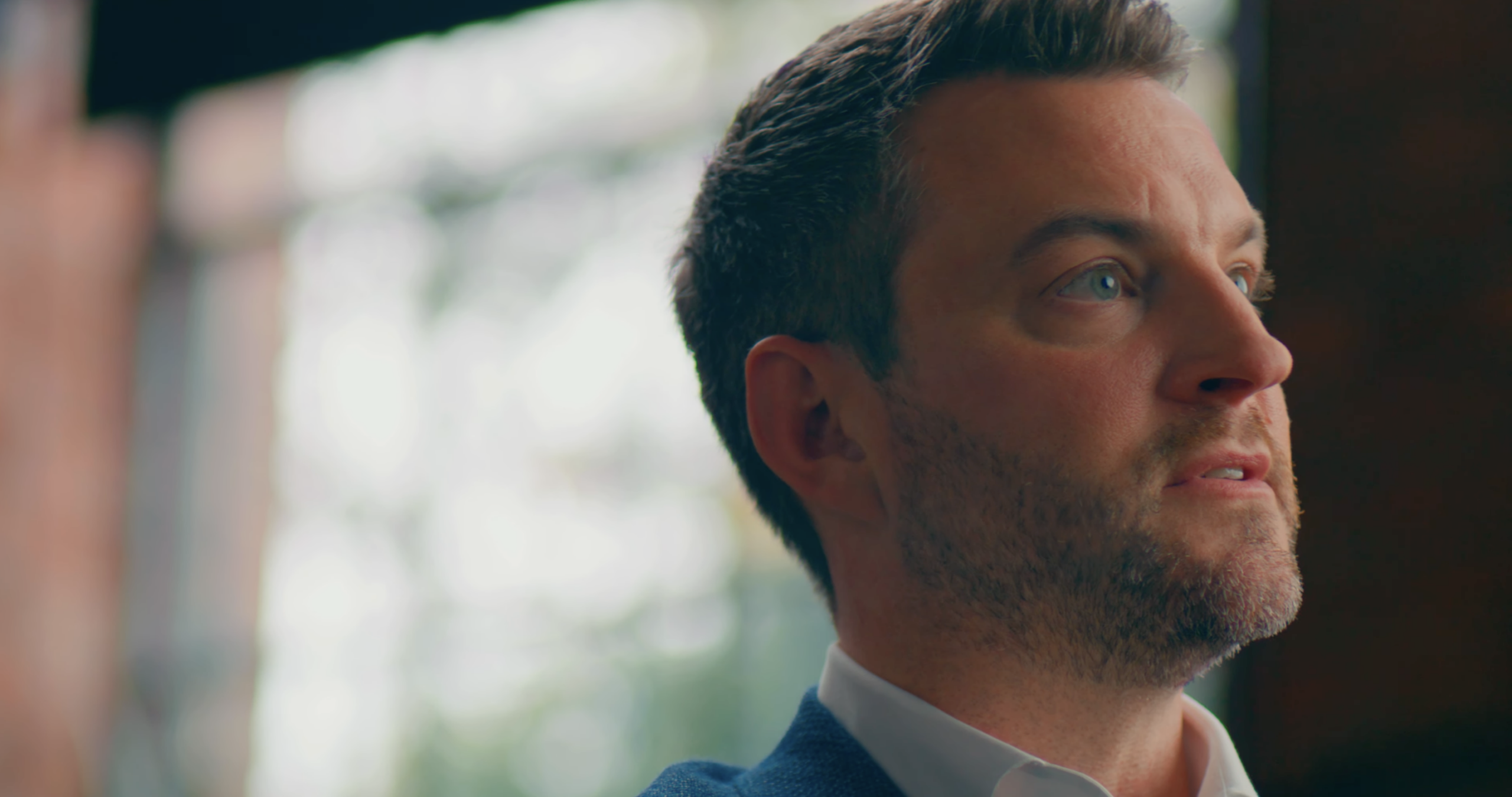
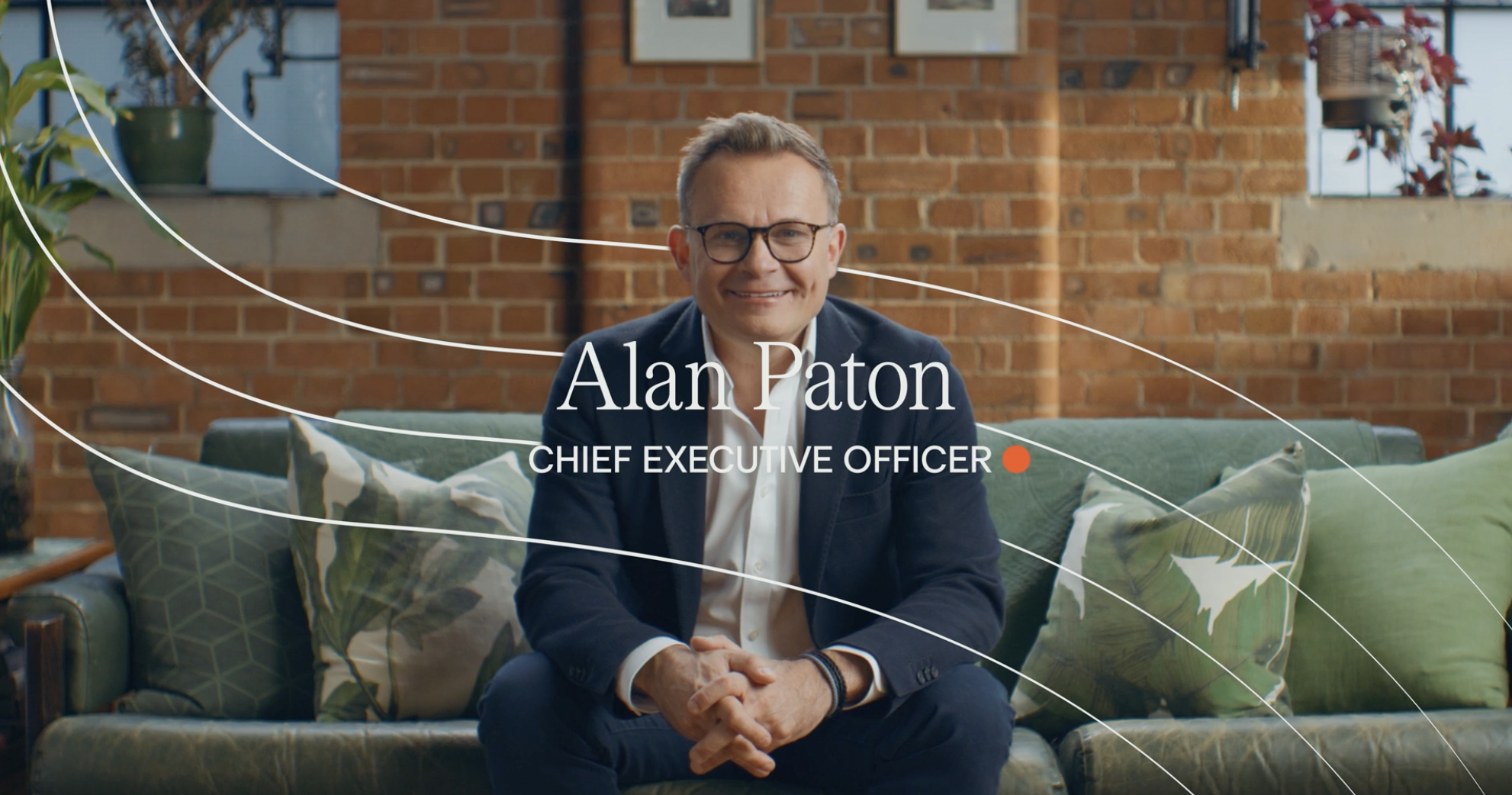
Four members of the executive team went on camera, each with an assigned lane: Alan Paton, Chief Executive Officer, on the history, the customers and the future; Divya Sampath, Chief Delivery Officer, on delivering at speed and scale; Dan Baker, Chief Information Security Officer, on security in a changed world; Margaux Tremac, Chief Innovation Officer, on AI and working at the front of new technology.
The scheduling detail that made it work: staggered one-hour slots from 9:30am, wrapped by 1:30pm. Each executive gave up an hour, not a day. If you’ve ever tried to get four C-suite diaries into one room, you’ll know the one-hour ask is usually the difference between “yes” and “next quarter”.
One more thing happened on that call sheet. At the end of his slot, Alan Paton recorded a short talk-to-camera piece for recruitment. Beyond was pushing hard on engineering hires, so we turned a rough standalone version of that clip around within days of the shoot — ahead of the main film — so the team could start using it immediately. On a schedule like this, workstreams overlap that would normally run in sequence: Beyond’s brand guidelines and font files landed with us on shoot day itself, and the motion language was built from them in the fortnight that followed.
Everything that came off that one day: the hero brand film in 4K, and three social cuts — Who Is Beyond?, Recruitment and The Future — each delivered in 16:9 and 9:16. Seven finished assets, one call sheet.
Lock the story before you polish it
The first cut we sent, on 11 June, deliberately wasn’t a first cut in the usual sense. It was a narrative assembly, and we said so before anyone pressed play: most of the motion graphics still to come, stock not yet integrated, pacing and music unfinished. Its only job was to answer one question — is this the right story, in the right order?
On a compressed timeline, this is the decision that matters most. Polish applied to the wrong structure is the most expensive mistake in post-production, because you pay for it twice: once to make it, once to unmake it. Locking the narrative first means every hour of animation, grade and mix that follows is spent on a structure everyone has already agreed.
It worked the way it’s supposed to. V1 came back with a clear direction — go more customer-first once the merger story is established, bring in the delivery centres in the Philippines and Argentina and what they mean for customers, keep the treatment of talent pointed at what engineering talent delivers. V2, delivered on 15 June, implemented all of it, and the narrative was signed off. The client’s read on it, for the record, was that the narrative was spot on. From that point, nobody touched the story. Everything after was finish.
The version-by-version record
V3, on 17 June, brought the animation in at scale — a 2D motion graphics language built out of Beyond’s own brand system rather than imposed on it. A dots animation, approved early and carried through. A line motif, refined mid-edit to move in parallel, because that’s how Beyond’s lines behave everywhere else in its brand world. A box treatment giving the interview footage structure and rhythm. A red accent. Lower thirds. And, after feedback that the film began too abruptly, an animated logo opening.
Just as useful is the record of what we made and then removed, because the iteration you can’t see is the part clients are actually paying for:
- A “pill” concept from the creative outline — dropped. It never sat naturally with the rest of the style.
- A grid animation built to accompany the dots — dropped as too busy. The dots stayed, and were softened.
- Group and collaborative shots — planned as an option, then deliberately abandoned. The client’s instinct, which was right, was that they’d read as cheesy here.
- Generic capability icons in the company structure animation — replaced, at the client’s suggestion and with logo files they supplied, by the real logos of the acquired companies. That animation maps CTS, Appsbroker, TIQQE, Tmc3 and Beyond LLC into one brand, and the real marks make the point in a way abstractions can’t.
V4 landed on 19 June with the refinements in. Compile on 22 June. Contracted delivery met on 23 June. The narrative had been approved at version two, and the Who Is Beyond? social cut cleared client review without a single note.
What a nineteen-day schedule actually requires
One decision-maker, almost to the end.
Feedback came through Joshua alone for the bulk of the process. Alan Paton was brought in deliberately late — once the piece was around 95% finished — so the person closest to the work steered it, and the chief executive’s time went on fine-tuning rather than fundamentals. Films die by committee. This one wasn’t allowed near one.
Notes by midday.
On the compressed weeks, we asked for feedback by midday so amends could be worked through the same afternoon. Every review cycle that spans a night costs a day, and enough of them cost the deadline.
Consolidated feedback, versioned properly.
Four numbered versions of the hero film were delivered against a contracted two rounds — the extra rounds approved in writing as scope grew. Every note was implemented against a numbered cut, so there was never a “which version are we watching?” moment. Unglamorous. Decisive.
What one commission became
The film was the commission. It wasn’t the end of the work. After delivery, the animated logo opening was extended into a title system for Beyond’s four-part podcast series, Beyond the Pilot — Agentic AI in Production. The motion graphics package was built to be reusable across future campaign assets rather than locked inside one edit. And the film shipped with a video identity handover document — a look book for how Beyond does video — which was in scope from the first proposal. The conversation has already moved on to what comes after September: podcasts, engineer profile content and global campaign assets.
That’s the quiet argument for doing launch films properly. A brand film made from a real brand system doesn’t just mark the date — it leaves behind a visual language the brand keeps building with. And the reason this project existed at all is worth restating: a marketing lead we’d worked with at a different company came back when the next brief was bigger. The best pipeline is the last project, delivered well.
If you’re staring at a fixed launch date
If you’ve got a launch date that can’t move and a film that doesn’t exist yet, the honest first step is a conversation about the schedule, not the script. We make brand video production and corporate video production work from our London HQ, with studios in Manchester, Bristol and Cornwall, and most of it starts with video production in London. Pricing is published on those pages — guessing games waste everyone’s time. We’ll tell you on day one whether your date is achievable, and what it would take.
The finished work is on the Beyond film page. If your date is closer than you’d like, drop us a line. Our team reads every email that comes in through the site within 2 working hours.
Questions commissioners actually ask
How long does a brand launch film take to produce?
The Beyond schedule ran 34 days from first conversation to contracted delivery, 19 days from contract signature, and 15 days from the shoot. The contracted post-production inside that: seven edit days, a grading day, an animation day. Given the choice we’d take five to six weeks — the three-week version works, but it demands a discipline most projects don’t need and shouldn’t pay for.
Can a brand film really be made in three weeks?
Yes, under three conditions: the story is locked before any polish is applied, one decision-maker holds feedback until the piece is nearly finished, and review windows are honoured — notes by midday, amends the same afternoon. Miss any one of the three and the date moves.
How many finished videos can one shoot day produce?
Beyond’s single day produced seven: a hero brand film in 4K, plus three social cuts, each in 16:9 and 9:16. The multiplier is planned in pre-production — interviews are directed with the cut-downs already in mind, not chopped out of the hero after the fact.
How do you film four executives in one day?
Staggered one-hour slots from 9:30am, wrapped by 1:30pm, each contributor with an assigned lane of talking points, and two cameras rolling so answers can be edited without a visible jump. Each executive gives up an hour, not a day — which is usually the difference between “yes” and “next quarter”.
What is an assembly cut, and why start with one?
An assembly cut is the film’s story laid out in full, start to finish, before the finishing layers go on — graphics unfinished, music temporary, pacing loose. Its job is to get the narrative approved before polish is spent on it, because polish applied to the wrong structure gets paid for twice. Beyond’s narrative was signed off at version two; nothing structural moved after that.
What does a brand launch film cost?
Brand films start at around £5,000 for simple shoots, with most running £7,000–£12,000 and complex, high-end productions going beyond £100,000. Those ranges are published on our brand video production and London pages, including what moves a budget up or down. A film at the level described here starts with a proper conversation about scope — but the published ranges are where that conversation begins.